Alluvi Glow Pen 70mg (BPC-157 10mg + TB-500 10mg + GHK-Cu 50mg)
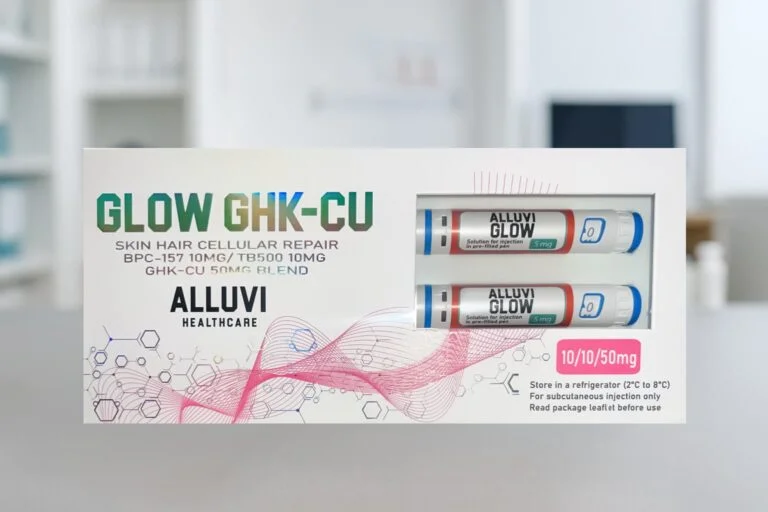
Research-grade three-peptide GLOW combination in a pre-filled pen: BPC-157 10mg, TB-500 10mg and GHK-Cu 50mg (70mg total). Manufacturer packaging by Alluvi Healthcare. HPLC + MS verified, per-batch COA. Research use only.
| Purity (HPLC) | >99% |
|---|---|
| Synonyms | Alluvi Glow, Glow GHK-Cu, GLOW pen, BPC-157 TB-500 GHK-Cu blend |
| Solubility | H2O |
| Storage | 2°C to 8°C (refrigerated) |
HPLC and MS verified by UKAS-accredited laboratories.
Free on orders over £50. Next-day upgrade available.
COA and batch number on every vial.
Alluvi Glow Pen — BPC-157 10mg / TB-500 10mg / GHK-Cu 50mg — research reference material
The Alluvi Glow Pen is a pre-filled multi-dose pen presentation of the three-peptide GLOW combination, supplied by NMChem as a research reference material. Each pack contains BPC-157 10 mg, TB-500 10 mg and GHK-Cu 50 mg (70 mg total, labelled 10/10/50 mg). It is supplied strictly for in-vitro laboratory research and is not for human or veterinary use.
Mechanism of research interest
This combination pairs two regenerative-research peptides with a copper tripeptide complex. BPC-157 is a synthetic pentadecapeptide studied in tissue-repair and angiogenesis models; TB-500 is a synthetic fragment related to thymosin beta-4, investigated for actin regulation and cell migration; and GHK-Cu is a copper-binding tripeptide studied in extracellular-matrix and dermal-research contexts. The three are combined here in a single pen format for convenience in comparative laboratory work. Compare these compounds side by side on our comparison tool.
Identifiers
- Composition: BPC-157 10 mg + TB-500 10 mg + GHK-Cu 50 mg (70 mg total)
- BPC-157 CAS number: 137525-51-0
- TB-500 CAS number: 885340-08-9
- GHK-Cu CAS number: 89030-95-5
- Synonyms: Alluvi Glow, Glow GHK-Cu, GLOW pen, BPC-157 / TB-500 / GHK-Cu blend
- Class: Peptide combination (regenerative-research peptides + copper tripeptide)
As a multi-component blend this product has no single CAS number; the component identifiers are listed above.
Format & quality
Supplied as a pre-filled pen (10/10/50 mg) in manufacturer packaging (Alluvi Healthcare). Identity and purity are characterised by reversed-phase HPLC and mass spectrometry, with a per-batch Certificate of Analysis available on request. The single-compound equivalents are also available individually — see BPC-157, TB-500 and GHK-Cu.
Storage
Per the manufacturer’s packaging, store refrigerated at 2 °C to 8 °C and protect from light. Confirm against the batch Certificate of Analysis.
Research use only — not for human or veterinary use, food, cosmetic or therapeutic application. NMChem supplies this item as a laboratory reference material; no dosing or administration guidance is provided.
Frequently asked questions
What does the Alluvi Glow Pen contain?
BPC-157 10 mg, TB-500 10 mg and GHK-Cu 50 mg — 70 mg total, labelled 10/10/50 mg — in a pre-filled pen in manufacturer packaging.
How does this differ from the GLOW Peptide Blend vial?
The composition is the same three peptides. This listing is the pre-filled pen presentation in Alluvi Healthcare packaging; our GLOW Peptide Blend 70mg is the lyophilised vial presentation.
Does it have a single CAS number?
No. It is a three-component blend, so there is no single CAS Registry Number. The CAS numbers for BPC-157, TB-500 and GHK-Cu are listed in the Identifiers section above.
How should it be stored?
The manufacturer’s packaging specifies refrigerated storage at 2 °C to 8 °C, protected from light. Always confirm against the Certificate of Analysis supplied with your batch.
Certificate of Analysis
Reconstitution
For peptides supplied as lyophilised powder, reconstitute in bacteriostatic water or sterile saline at the concentration appropriate to your protocol. Allow the vial to come to room temperature before opening, add solvent slowly down the inside wall (do not directly onto the powder), and gently invert until clear. Do not vortex.
Reconstituted solutions are typically stable at 2–8°C for the durations published in the corresponding peer-reviewed reference. For long-term storage, aliquot and freeze at −20°C; avoid repeated freeze–thaw cycles.
You may also need
Related compounds