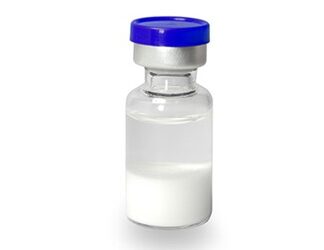
Sermorelin Acetate 5mg
GHRH(1-29) analogue · research grade · HPLC + MS verified · per-batch COA. Research use only.
| Purity (HPLC) | >=99% |
|---|---|
| CAS number | 86168-78-7 |
| Synonyms | Sermorelin, GRF(1-29), GHRH(1-29), Geref |
Only 10 left in stock
HPLC and MS verified by UKAS-accredited laboratories.
Free on orders over £50. Next-day upgrade available.
COA and batch number on every vial.
Sermorelin acetate is a synthetic 29-amino-acid analogue corresponding to the biologically active N-terminal fragment of growth-hormone-releasing hormone, GHRH(1–29), supplied as the acetate salt. It is studied in growth-hormone-axis and secretagogue research and is supplied by NMChem as a research reference material.
As a GHRH-receptor analogue it belongs to the same mechanism class as CJC-1295 and tesamorelin, and is distinct from the growth-hormone secretagogue-receptor agonists such as ipamorelin and GHRP-2, which reach the same axis through a different receptor. The comparison tool sets the classes side by side.
Note on the acetate salt
This listing is supplied as the acetate rather than the trifluoroacetate salt. That is a deliberate distinction: reversed-phase purification normally leaves a TFA counterion behind, and an explicit salt-exchange step is required to replace it. Acetate is preferred where residual TFA would interfere with a downstream system. The counterion also contributes mass, which is one of the reasons the nominal vial weight overstates the peptide present — molar mass and solution concentration covers the correction, and how research peptides are made explains where the counterion comes from in the first place.
Presentation
5 mg lyophilised powder, SKU SERM5.
Documentation
A Certificate of Analysis is produced per batch and is available on request against the lot number printed on the vial. Characterised by reversed-phase HPLC for purity and by mass spectrometry for identity. If you have not worked with this kind of report before, how to read a Certificate of Analysis walks through each section, and identity vs purity explains why the two headline numbers answer different questions.
Handling
Supplied lyophilised. Allow the sealed vial to reach room temperature before opening so atmospheric moisture does not condense onto cold glass, add solvent slowly down the vial wall rather than directly onto the cake, and dissolve without vortexing. Store the dry material at −20 °C, protected from light; aliquot reconstituted stock before freezing so no portion is thawed more than once. Storage and stability covers the degradation routes these steps are guarding against, and molar mass and solution concentration covers the arithmetic — including why the nominal vial weight is not the mass of peptide present. Practical procedure is in the reconstitution guide.
Research use only. Supplied for in-vitro research and laboratory use. Not for human or veterinary use, not a medicine, and not for food or cosmetic application. See the compliance page for the framework NMChem operates under.
Certificate of Analysis
Reconstitution
For peptides supplied as lyophilised powder, reconstitute in bacteriostatic water or sterile saline at the concentration appropriate to your protocol. Allow the vial to come to room temperature before opening, add solvent slowly down the inside wall (do not directly onto the powder), and gently invert until clear. Do not vortex.
Reconstituted solutions are typically stable at 2–8°C for the durations published in the corresponding peer-reviewed reference. For long-term storage, aliquot and freeze at −20°C; avoid repeated freeze–thaw cycles.
Research literature
Selected peer-reviewed publications from PubMed referencing this compound. Provided for research orientation — not an endorsement of any clinical application. Each citation links to the canonical PubMed record.
-
Therapeutic Peptides in Orthopaedics: Applications, Challenges, and Future Directions.
Rahman OF et al. · Journal of the American Academy of Orthopaedic Surgeons. Global research & reviews · 2026
PubMed PMID 41490200 -
Sermorelin: a better approach to management of adult-onset growth hormone insufficiency?.
Walker RF et al. · Clinical interventions in aging · 2006
PubMed PMID 18046908 -
Advances in the detection of growth hormone releasing hormone synthetic analogs.
Memdouh S et al. · Drug testing and analysis · 2021
PubMed PMID 34665524 -
A potentially effective drug for patients with recurrent glioma: sermorelin.
Chang Y et al. · Annals of translational medicine · 2021
PubMed PMID 33842627 -
Sermorelin: a review of its use in the diagnosis and treatment of children with idiopathic growth hormone deficiency.
Prakash A et al. · BioDrugs : clinical immunotherapeutics, biopharmaceuticals and gene therapy · 1999
PubMed PMID 18031173 -
Safety and Efficacy of Approved and Unapproved Peptide Therapies for Musculoskeletal Injuries and Athletic Performance.
Mendias CL et al. · Sports medicine (Auckland, N.Z.) · 2026
PubMed PMID 41966639
You may also need