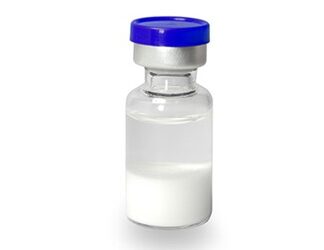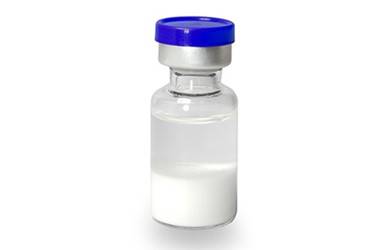
Melanotan I 10mg
Alpha-MSH analogue · research grade · HPLC + MS verified · per-batch COA. Research use only.
| Purity (HPLC) | >=99% |
|---|---|
| CAS number | 75921-69-6 |
| Synonyms | Melanotan 1, Melanotan-I, Afamelanotide, NDP-MSH, [Nle4-D-Phe7]-alpha-MSH |
Only 1 left in stock
HPLC and MS verified by UKAS-accredited laboratories.
Free on orders over £50. Next-day upgrade available.
COA and batch number on every vial.
Melanotan I (afamelanotide; [Nle4-D-Phe7]-α-MSH) is a synthetic 13-residue analogue of alpha-melanocyte-stimulating hormone, studied in melanocortin-receptor and pigmentation research. It is supplied by NMChem as a research reference material.
The two substitutions
The name records exactly what was changed from the native sequence, and both changes are stabilising rather than incidental. Replacing methionine at position 4 with norleucine removes the sulfur atom that makes methionine the most oxidation-prone residue in a peptide — one of the main degradation routes described in storage and stability. Substituting D-phenylalanine at position 7 for the natural L-form introduces a residue that proteases do not readily cleave.
There is an analytical consequence worth noting: D- and L-amino acids have identical masses, so mass spectrometry cannot by itself confirm that position 7 carries the D-form. What mass spectrometry tells you covers stereochemistry among the four things a mass spectrum cannot resolve.
Melanotan I is a distinct molecule from Melanotan II, which is cyclic and shorter; the two are frequently conflated. NMChem also lists PT-141, a further melanocortin-system compound.
Presentation
10 mg lyophilised powder, SKU MT1-10.
Documentation
A Certificate of Analysis is produced per batch and is available on request against the lot number printed on the vial. Characterised by HPLC for purity and by mass spectrometry for identity. If you have not worked with this kind of report before, how to read a Certificate of Analysis walks through each section, and identity vs purity explains why the two headline numbers answer different questions.
Handling
Supplied lyophilised. Allow the sealed vial to reach room temperature before opening so atmospheric moisture does not condense onto cold glass, add solvent slowly down the vial wall rather than directly onto the cake, and dissolve without vortexing. Store the dry material at −20 °C, protected from light; aliquot reconstituted stock before freezing so no portion is thawed more than once. Storage and stability covers the degradation routes these steps are guarding against, and molar mass and solution concentration covers the arithmetic — including why the nominal vial weight is not the mass of peptide present. Practical procedure is in the reconstitution guide.
Research use only. Supplied for in-vitro research and laboratory use. Not for human or veterinary use, not a medicine, and not for food or cosmetic application. See the compliance page for the framework NMChem operates under.
Certificate of Analysis
Reconstitution
For peptides supplied as lyophilised powder, reconstitute in bacteriostatic water or sterile saline at the concentration appropriate to your protocol. Allow the vial to come to room temperature before opening, add solvent slowly down the inside wall (do not directly onto the powder), and gently invert until clear. Do not vortex.
Reconstituted solutions are typically stable at 2–8°C for the durations published in the corresponding peer-reviewed reference. For long-term storage, aliquot and freeze at −20°C; avoid repeated freeze–thaw cycles.
Research literature
Selected peer-reviewed publications from PubMed referencing this compound. Provided for research orientation — not an endorsement of any clinical application. Each citation links to the canonical PubMed record.
-
Afamelanotide.
2012
PubMed PMID 38598652 -
Afamelanotide in protoporphyria and other skin diseases: a review.
Polańska A et al. · Postepy dermatologii i alergologii · 2024
PubMed PMID 38784937 -
.
2023
PubMed PMID 40258105 -
Afamelanotide for prevention of phototoxicity in erythropoietic protoporphyria.
Wensink D et al. · Expert review of clinical pharmacology · 2021
PubMed PMID 33507118 -
Afamelanotide: An Orphan Drug with Potential for Broad Dermatologic Applications.
Wu J et al. · Journal of drugs in dermatology : JDD · 2021
PubMed PMID 33683075 -
Afamelanotide: A Review in Erythropoietic Protoporphyria.
Kim ES et al. · American journal of clinical dermatology · 2016
PubMed PMID 26979527
You may also need
Related compounds