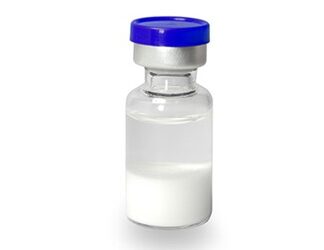
Acetic Acid 10ml (Peptide Reconstitution Solvent)
Size: 10ml | Analytical Grade
M.Wt: 60.05
Formula: CH3COOH
Purity: >99%
CAS No.: 64-19-7
| Purity (HPLC) | >99% |
|---|---|
| Molecular weight | 60.05 g/mol |
| Molecular formula | CH3COOH |
| CAS number | 64-19-7 |
| Synonyms | Acetic Acid, Ethanoic Acid, Glacial Acetic Acid |
| Solubility | H2O |
| Storage | -20°C / 3 years |
Back-in-stock notification
Out of stock. Leave your email and we will notify you when it returns.
HPLC and MS verified by UKAS-accredited laboratories.
Free on orders over £50. Next-day upgrade available.
COA and batch number on every vial.
Glacial acetic acid supplied as an aqueous solution for laboratory use, principally as a reconstitution solvent for peptides that dissolve poorly in neutral water. Formula CH3COOH, molecular weight 60.05, CAS 64-19-7.
Why a dilute acid is used
Peptide solubility is governed largely by net charge. Sequences rich in basic residues — lysine, arginine, histidine — carry more positive charge at acidic pH, which increases solvation and suppresses the aggregation that leaves an incompletely dissolved cake behind. A small volume of dilute acetic acid is the standard first step for such sequences, followed by dilution into the working aqueous medium once dissolution is complete.
The corollary matters as much: sequences rich in acidic residues behave the opposite way, and for those a dilute base such as ammonium bicarbonate is the appropriate first solvent. Solvent choice follows from the sequence, not from habit. Where NMChem holds documented solubility data for a compound it is recorded on the corresponding research reference page.
Presentation
10 ml, analytical grade, >99%, SKU AA10. Supplied as an aqueous solution.
Handling
Acetic acid is corrosive and volatile. Handle in adequate ventilation with appropriate personal protective equipment and observe the safety data for the concentration you are working with. Carried-over acid affects the pH of the final solution, which in turn affects the hydrolysis and deamidation rates described in storage and stability — so the dilution step is not merely a volume adjustment. Procedure is set out in the reconstitution guide; the arithmetic is in molar mass and solution concentration.
Research use only. Supplied for in-vitro research and laboratory use. Not for human or veterinary use, not a medicine, and not for food or cosmetic application. See the compliance page for the framework NMChem operates under.
Certificate of Analysis
Reconstitution
For peptides supplied as lyophilised powder, reconstitute in bacteriostatic water or sterile saline at the concentration appropriate to your protocol. Allow the vial to come to room temperature before opening, add solvent slowly down the inside wall (do not directly onto the powder), and gently invert until clear. Do not vortex.
Reconstituted solutions are typically stable at 2–8°C for the durations published in the corresponding peer-reviewed reference. For long-term storage, aliquot and freeze at −20°C; avoid repeated freeze–thaw cycles.
Research literature
Selected peer-reviewed publications from PubMed referencing this compound. Provided for research orientation — not an endorsement of any clinical application. Each citation links to the canonical PubMed record.
-
Acetic acid bacteria.
RAO MRR et al. · Annual review of microbiology · 1957
PubMed PMID 13470823 -
OXIDATION OF ALIPHATIC GLYCOLS BY ACETIC ACID BACTERIA.
DELEY J et al. · Bacteriological reviews · 1964
PubMed PMID 14172022 -
Acetic acid removal from corn stover hydrolysate using ethyl acetate and the impact on Saccharomyces cerevisiae bioethanol fermentation.
Aghazadeh M et al. · Biotechnology progress · 2016
PubMed PMID 27090191
You may also need
Related compounds