Human Growth Hormone
Size: 40IU | 99% Purity
M.Wt: 22124.0
Formula: C990H1529N263O299S7
Solubility: H2O
Purity: >99%
Storage: -20°C / 3 years
Half life: Not established
CAS No.: 12629-01-5
| Available sizes | 24IU · 36IU · 40IU |
|---|---|
| Purity (HPLC) | >99% |
| Molecular weight | 22124.0 g/mol |
| Molecular formula | C990H1529N263O299S7 |
| CAS number | 12629-01-5 |
| Synonyms | Somatropin, Somatotropin, rHGH, GH |
| Solubility | H2O |
| Storage | -20°C / 3 years |
| Half-life | Not established |
Peptide sequence
Phe-Pro-Thr-Ile-Pro-Leu-Ser-Arg…HPLC and MS verified by UKAS-accredited laboratories.
Free on orders over £50. Next-day upgrade available.
COA and batch number on every vial.
Human growth hormone (somatropin) is a 191-amino-acid single-chain polypeptide of approximately 22.1 kDa, CAS 12629-01-5, containing two intramolecular disulfide bridges. It is supplied by NMChem as a research reference material.
Background, mechanism and published research context are on the HGH research reference page.
Why potency is quoted in IU
This listing is specified in international units rather than in milligrams, and the reason is analytically interesting. For a large, folded, disulfide-bonded protein, biological activity depends on conformation as well as on the amino-acid sequence — a correctly sequenced molecule that has misfolded or formed incorrect disulfide pairings has the same mass and very different activity. Mass alone is therefore a weaker proxy for potency than it is for a short linear peptide, and an IU specification refers back to a biological activity standard instead.
The practical consequence for reading documentation: a mass-spectrometric identity result and an HPLC purity figure establish rather less about a folded protein than they do about a 10-residue peptide. Identity vs purity covers the general distinction; for proteins of this size, correct folding is a third question that neither measurement directly answers.
Presentation
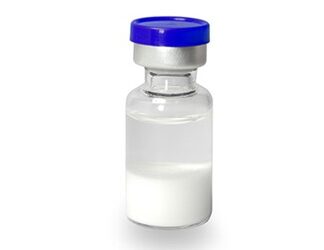
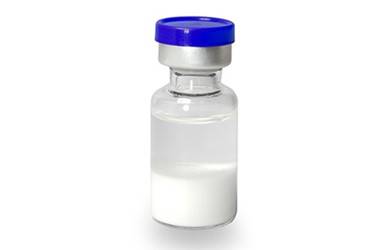
Lyophilised powder, SKU HGH40. Reconstitution solvent is supplied separately — see bacteriostatic water.
Documentation
A Certificate of Analysis is produced per batch and is available on request against the lot number printed on the vial. If you have not worked with this kind of report before, how to read a Certificate of Analysis walks through each section, and identity vs purity explains why the two headline numbers answer different questions.
Handling
Supplied lyophilised. Allow the sealed vial to reach room temperature before opening so atmospheric moisture does not condense onto cold glass, add solvent slowly down the vial wall rather than directly onto the cake, and dissolve without vortexing. Store the dry material at −20 °C, protected from light; aliquot reconstituted stock before freezing so no portion is thawed more than once. Storage and stability covers the degradation routes these steps are guarding against, and molar mass and solution concentration covers the arithmetic — including why the nominal vial weight is not the mass of peptide present. Practical procedure is in the reconstitution guide.
UK status. Somatropin is a prescription-only medicine in the UK. This listing is a research reference material supplied for in-vitro laboratory use only. Are peptides legal in the UK? sets out the framework, and the compliance page covers how NMChem operates within it.
Research use only. Supplied for in-vitro research and laboratory use. Not for human or veterinary use, not a medicine, and not for food or cosmetic application. See the compliance page for the framework NMChem operates under.
Certificate of Analysis
Reconstitution
For peptides supplied as lyophilised powder, reconstitute in bacteriostatic water or sterile saline at the concentration appropriate to your protocol. Allow the vial to come to room temperature before opening, add solvent slowly down the inside wall (do not directly onto the powder), and gently invert until clear. Do not vortex.
Reconstituted solutions are typically stable at 2–8°C for the durations published in the corresponding peer-reviewed reference. For long-term storage, aliquot and freeze at −20°C; avoid repeated freeze–thaw cycles.
You may also need
Related compounds